The First Photograph in the World (1827)
In the summer of 1827, Joseph Nicéphore Niépce set up a camera obscura at the window of his workroom on the Le Gras estate in Saint-Loup-de-Varennes, France, and exposed a bitumen-coated pewter plate for several days. The result is the oldest permanently preserved photograph in the world: Point de vue du Gras — a view over the courtyard in which the sun appears to shine from both left and right, because it moved across the sky during the days-long exposure.
The image is now held at the Harry Ransom Center at the University of Texas at Austin. It measures 16.5 × 21 cm, is fixed on a pewter plate, and—depending on the viewing angle—appears alternately as a negative and a positive. It exists as a single object. There is no copy.
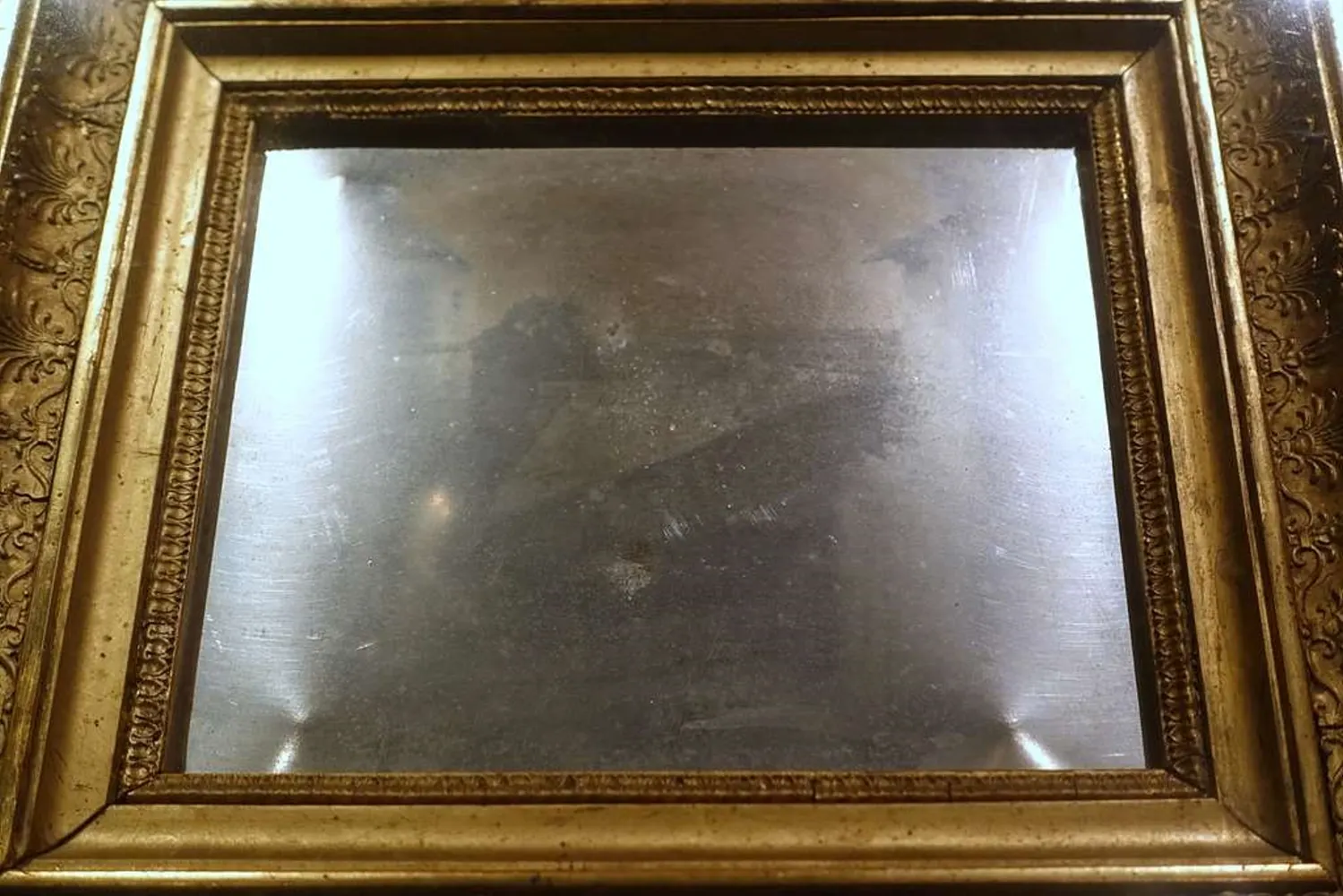
View from the Window at Le Gras, by Joseph Nicephore Niepce, 1826 or 1827, France – Harry Ransom Center – University of Texas at Austin
How the Image Was Made — The Camera Obscura Process
In the preceding years, Niépce had developed a contact process: copying prints onto bitumen-coated plates through direct exposure to light. The camera obscura process is the next step—and a fundamentally different one. Here, the plate does not capture a copy, but the visible world itself: through a lens, through an aperture, over the course of several days.
The plate was coated with bitumen dissolved in lavender oil and dried on an iron support. It was then placed inside the camera obscura, the window was opened—and he waited. For several days. The more strongly illuminated areas of the courtyard hardened the bitumen; the darker areas remained soft. After exposure, Niépce washed away the soft parts with a mixture of lavender oil and white petroleum. What remained was permanent.
→ More on the technical process: The heliographic contact process (1822)
. . .
When Was the Image Created? — The Question of Dating
For a long time, the year of creation was broadly given as “1826 or 1827.” However, source-critical research has since refined this dating. Based on Niépce’s letters, the documented delivery of a lens by the optician Chevalier, and experimental reconstructions, the timeframe can be narrowed down to June–July 1827—earlier technical production was simply not possible.
Helmut Gernsheim, who rediscovered the image in 1952 and initially dated it to 1826, later revised his assessment to 1827.
→ Full evidentiary chain: Niépce’s heliography — dating to 1827 (research article, Medium)
. . .
The Lost Image of 1824
There is an earlier image—but it no longer exists. On September 16, 1824, Niépce wrote to his brother Claude that he had finally obtained a view as he had wished: with remarkable clarity, the finest gradations of tone, and an effect that— in his words—“has truly something magical about it.” He describes how the plate had to be tilted at an angle to perceive the image.
The image itself is gone. Niépce polished the plate away—the expensive metal plates of the time were reused. What remains is the letter.
“Depiction of the objects is of astonishing clarity and detail, down to the smallest features and the subtlest shades. This effect truly has something magical about it.”
— Niépce, letter to Claude, September 16, 1824
What lingers in this letter is that it is the first known description of a photographic image ever written—and the image itself is no longer there. Photography begins with a loss: an image that exists only in language, that forms itself in the reader’s imagination. Two hundred years later, we read Niépce’s words and picture what he saw. Each of us a different version.
Is 1824 the true birth year of photography? Or does only what survives count? The question remains open—and it is not purely historical.
→ More: The history of the first photograph — the lost image of 1824 (Medium)
The Image Today — Point de vue du Gras at the Harry Ransom Center
The image was rediscovered in 1952 by Helmut Gernsheim and his wife Alison in a storage room in London, after having been considered lost for decades. In 1963, the Harry Ransom Center acquired it for its collection.
It is not an image that can simply be looked at. The plate must be tilted, the light adjusted, the angle carefully found. For a moment it appears as a negative, then as a positive. The image does not exist without the viewer’s attention—it requires it.
. . .
My Reconstruction — View of Mihaela’s Garden
In June 2023, I attempted to recreate Niépce’s 1827 process—using the same materials, the same method, the same principle. I used my smallest roll-film camera, roughly 6 × 9 cm in size, cut a piece of galvanized metal sheet, and applied a bitumen emulsion that was about a year old. After drying it on a heated iron plate, it formed a light-brown, glossy surface.
I placed the camera on a terrace, pointed at an old plum tree in Mihaela’s garden—about a hundred years old. Then I waited. Not hours. Days.
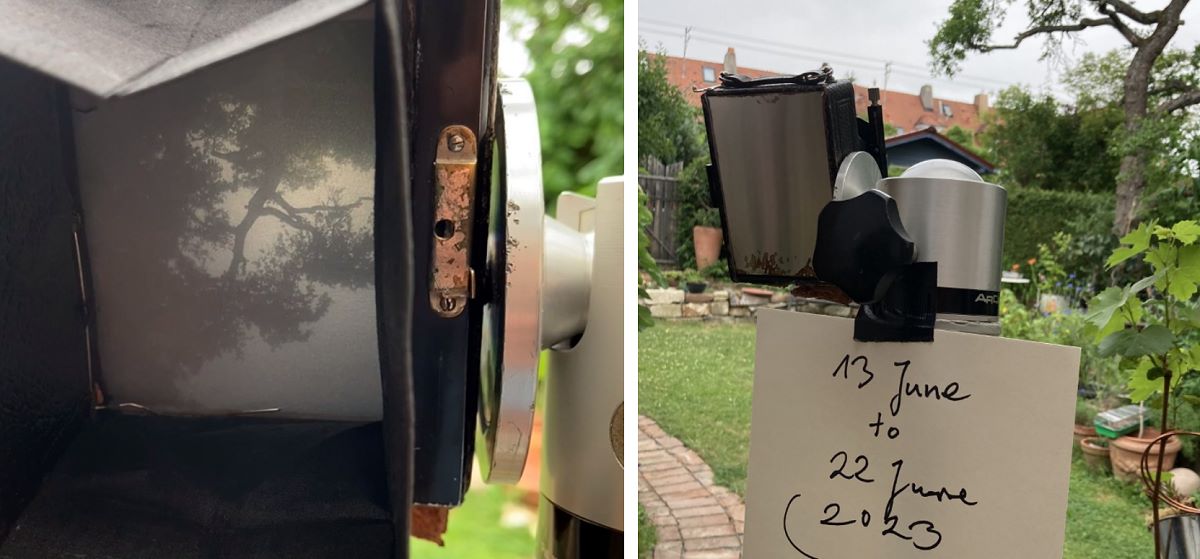
Camera placed on the terrace, pointed at the plum tree — © Przemek Zajfert
Day one, two, three—nothing visible on the surface. Somewhere beneath the matte layer, photons were at work, breaking molecular bonds, hardening the asphalt grain by grain. Each evening I covered the camera. Each morning the tension was the same.
After seven days I opened the camera. My hands were trembling—not from excitement, but from fear. What if there was nothing there?
I immersed the plate in diluted lavender oil. One minute passed. Nothing. Then—suddenly—it appeared. A delicate, almost secret image, visible only at the correct angle. And then: a fingerprint. My own, pressed into the fresh emulsion.
First thought: throw it away, start again. Second thought: no. That fingerprint belongs to this image. It is part of its history—like time, light, patience, and error.
→ Photography on Asphalt – Reconstructing Niepce’s First Photograph (Medium)

View of Mihaela’s Garden | Heliography after Niépce (1827) | Exposure: June 13–22, 2023 | 8 sunny days | Camera obscura, bitumen on metal plate | © Przemek Zajfert
. . .
Sources
- Notice sur l’héliographie, 1829, Joseph Nicéphore Niépce — Bibliothèque nationale de France
- Pierre G. Harmant / Paul Marillier: Some Thoughts on the World’s First
- Photograph. The Photographic Journal, Royal Photographic Society, London, 1967
- Harry Ransom Center, University of Texas at Austin: Niépce Heliograph Collection
- Helmut Gernsheim: Geschichte der Photographie. Die ersten hundert Jahre. Propyläen Verlag, Frankfurt 1983
- Jean-Louis Marignier: experimentelle Rekonstruktion der Heliografie (2008)
. . .